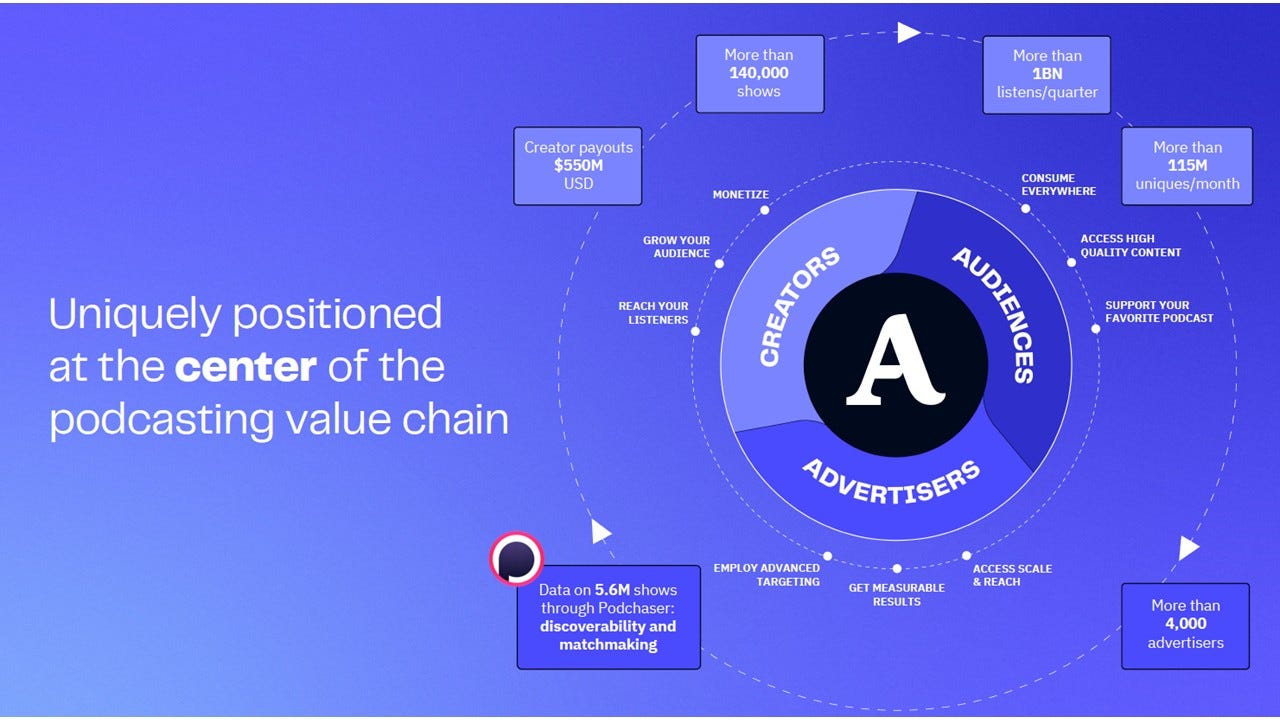
Acast ($ACAST.ST) is a SEK 4.6 billion (€430 million) Swedish company that provides a platform to host and distribute podcasts while at the same time offering a marketplace for advertising services and monetisation opportunities for podcast creators.
Acast is the self-proclaimed global independent power source of podcasting: more than 140,000 shows rely on its technology for the hosting and monetisation of their audio content on a weekly basis, from some of the most popular podcasts in the world (like the Financial Times, PBS, The Economist, TED, Off Menu, …) to smaller podcasts with only a few listeners.


Acast was already briefly introduced in December 2024 in “10 micro-caps for 2025”, where at the end I said:
“Despite all these shortcomings for a self-professed value investor, I intend to dig deeper into the company and will likely write a longer analysis.”
So, here is a longer deep dive (quite long, with a detailed analysis of the business model and the underlying market…).
History
Founded in Stockholm in 2014 with a name inspired by the egalitarian principle that “Anyone Can Make A Cast”, the company initially focused on providing the technical infrastructure necessary to bridge the gap between amateur content creation and professional monetisation: the first decade of its existence was defined by rapid geographic expansion and a focus on establishing a footprint in the most lucrative advertising markets globally. By 2016, Acast had moved beyond its Nordic roots to open an office in New York City, recognising that the US would eventually represent the largest and most mature advertising market for the medium. This expansion was followed by the establishment of offices in London, Dublin, Paris, Berlin, and Sydney, creating a truly global sales network that could sell local inventory to international brands.
The company’s growth was fuelled by a series of strategic acquisitions designed to bolster its technology stack and data capabilities. Pippa, a podcast hosting and analytics platform acquired in 2019, allowed Acast to expand its offerings to early-stage and independent podcasters, effectively broadening its “long tail” of content. RadioPublic (acquired in 2020) further strengthened the company’s commitment to an open ecosystem, ensuring that listeners could access content across any application without being locked into a proprietary walled garden. That was followed in 2022 by Podchaser, the world’s most comprehensive podcast database, which provided Acast with over 4.5 million tracked podcasts and 1.7 billion data points, giving the company a metadata advantage that allows advertisers to target audiences with a precision that was previously the exclusive domain of closed platforms.
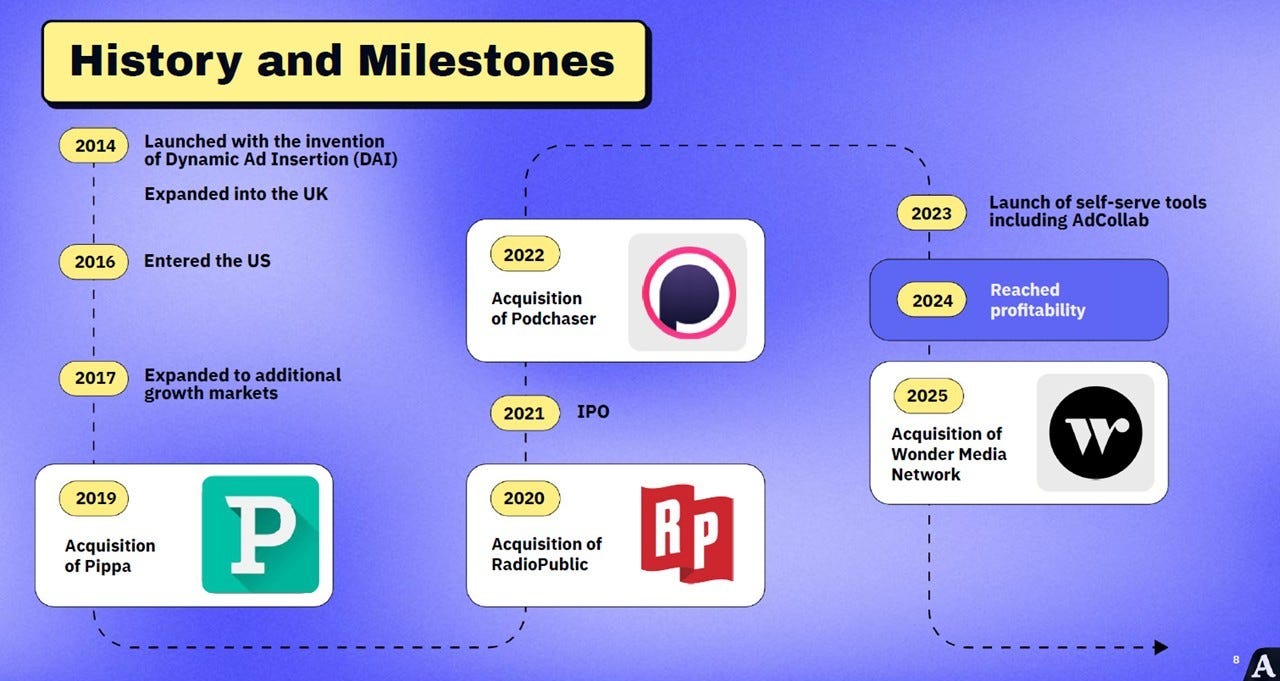
The company IPOed in 2021 on the Swedish stock exchange to raise the capital needed to compete in a market increasingly dominated by tech giants. Today, the largest shareholders are still VC/growth funds (Bonnier Ventures 17%, Alfvén & Didrikson 13%, Moor&Moor 10%), with the rest of the free float owned mostly by local long-term investors (family offices and pension funds).
Business model: scaling the open podcast ecosystem
The global audio landscape has undergone a radical transformation over the last decade, transitioning from a niche hobbyist medium into a sophisticated, multi-billion-dollar advertising pillar.
Acast operates as a multi-sided marketplace that solves fundamental structural problems for three distinct customer groups: creators, advertisers, and listeners. At its core, the company provides a technology-driven bridge that connects fragmented supply with sophisticated demand.