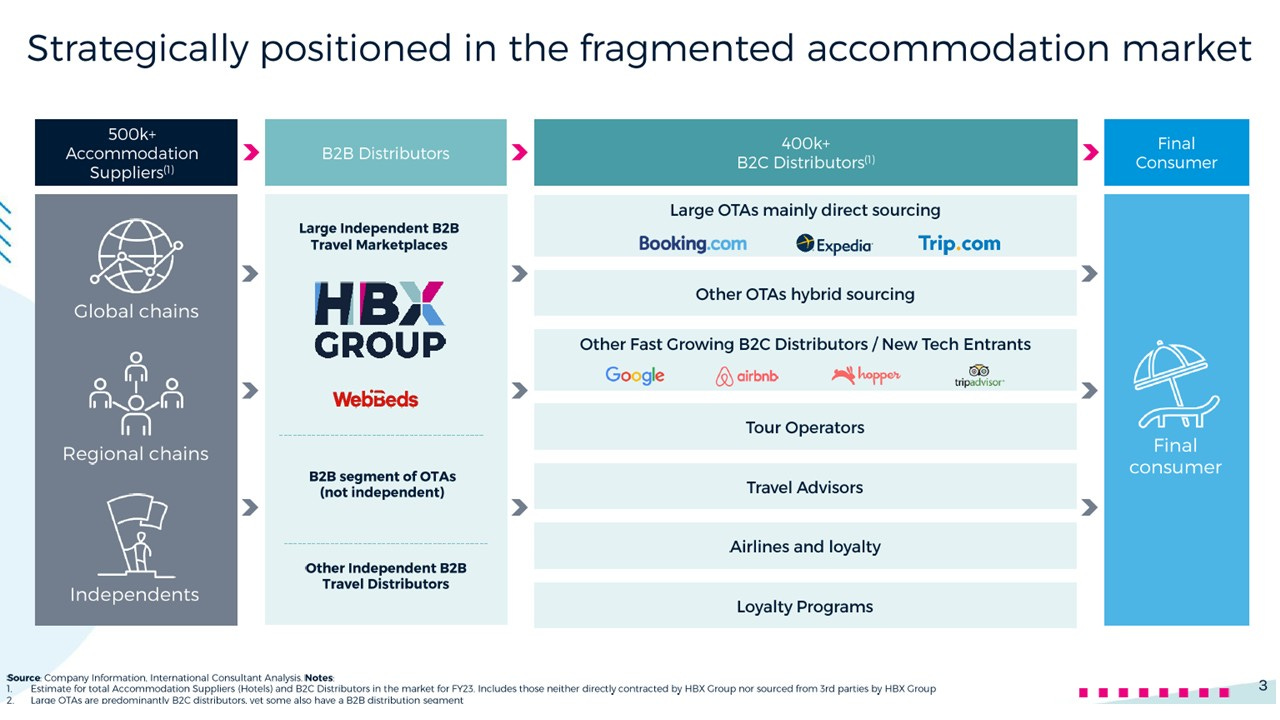

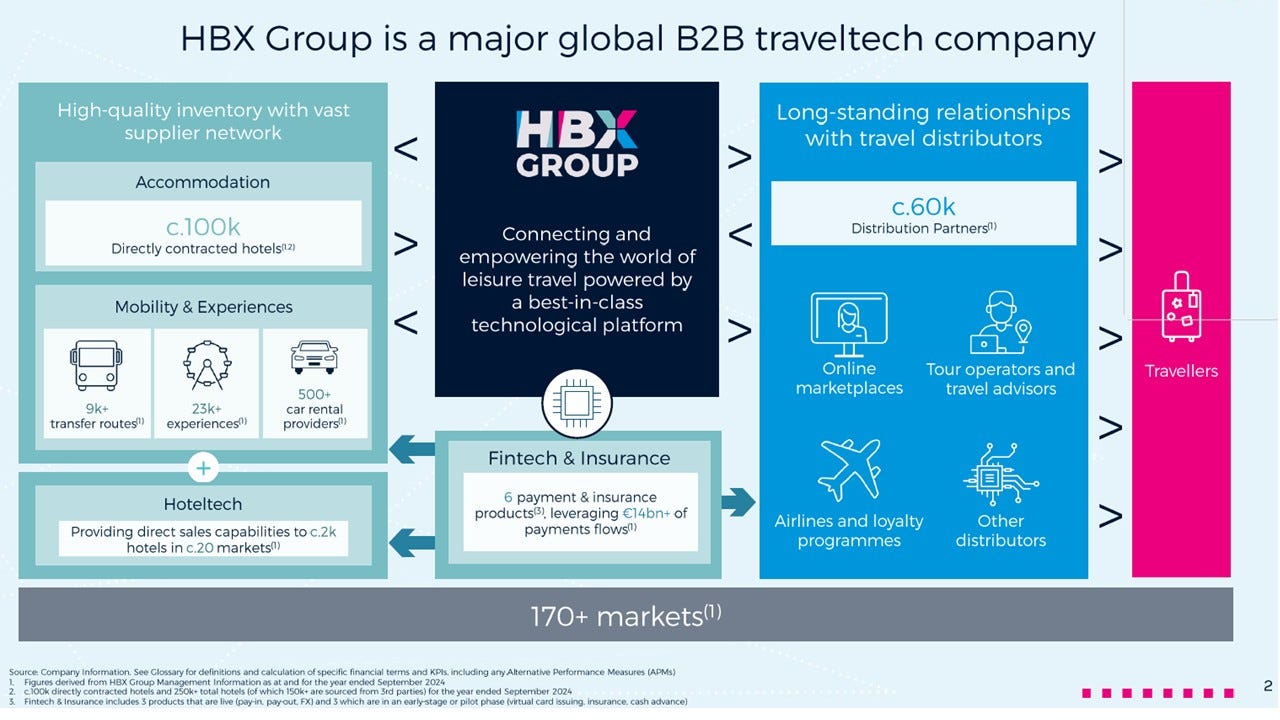
HBX Group International ($HBX.MC) is a €1.7 billion B2B travel distribution marketplace for accommodation, mobility and experiences: it aggregates travel inventory from suppliers, distributes it to a global network of sellers, and monetises the spread via commissions, markups, and value-added tech/services.
Origins and evolution
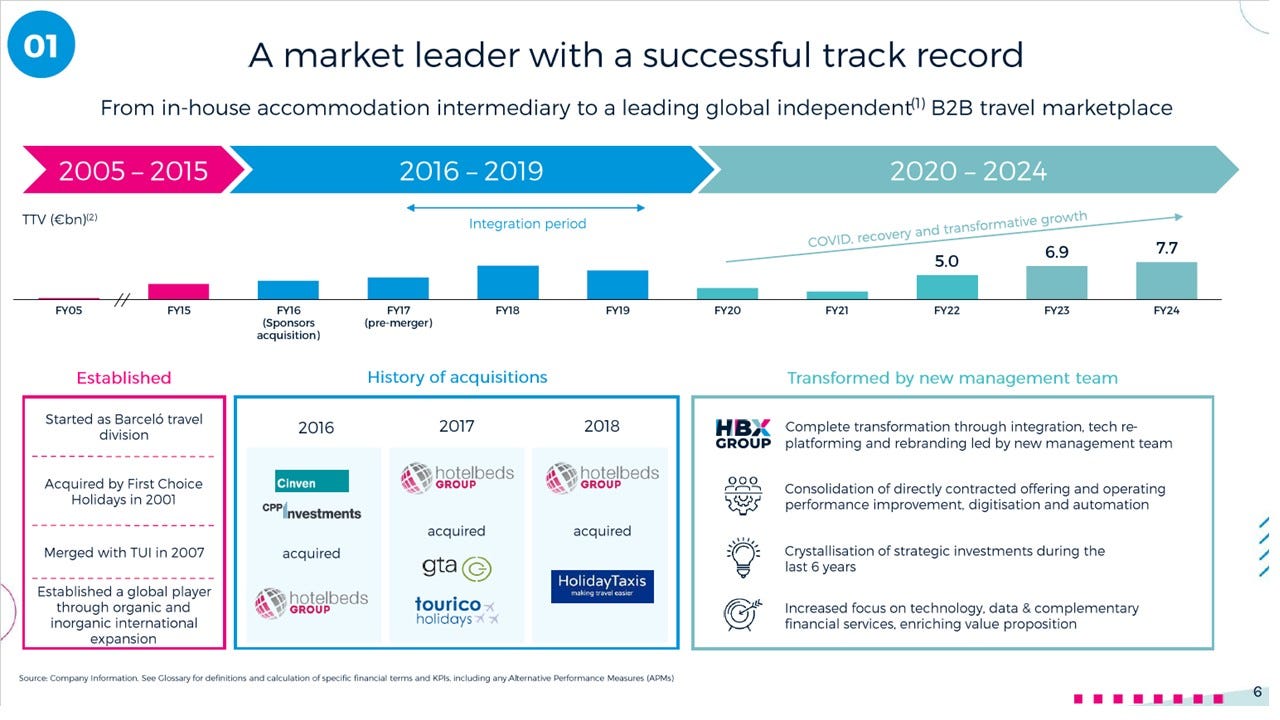
The story begins with the Barceló Group, a major Spanish tourism conglomerate founded in 1931 which provided destination management services (transfers, local excursions, hotel booking handling) for international tour operators bringing tourists into Spain: in 2000, Barceló integrated its entire incoming travel and retail division into First Choice Holidays, becoming its largest single shareholder.1
In 2001 Hotelbeds was officially launched in Palma de Mallorca as a dedicated B2B unit within First Choice Holidays, pioneering the “bedbank” concept:2 it focused heavily on building early API integrations, enabling global distributors to pull real-time hotel availability directly into their booking engines.
First Choice Holidays was eventually merged with the tourism division of Germany’s TUI AG in 2007 to create TUI Travel. During this period, it built the core European bedbank network under the Hotelbeds brand, to which it was rebranded in 2015 following the formation of what is today TUI Group ($TUI1.DE). The combined group had also acquired Roiback in 2014 to strengthen its digital capabilities in direct hotel distribution.
The defining structural shift occurred in September 2016, when private equity firms Cinven and the Canada Pension Plan Investment Board (CPPIB) acquired the business from TUI for approximately €1.2 billion, establishing it as an independent entity. This was the inflection point that brought capital and management focus on scale and technology: under private equity ownership, the company embarked on an aggressive inorganic consolidation campaign to build global scale, acquiring in 2017 its two largest global bedbank competitors (Tourico Holidays and GTA Travel)3, effectively doubling the size of the business by sales and significantly increasing its market presence in North America and Asia-Pacific. Non-core destination management assets under the MTS Globe brand were divested to focus on the core wholesale accommodation model; in parallel, Hotelbeds acquired HolidayTaxis Group in 2018, reinforcing its ancillary Mobility & Experiences segment.
While the company was integrating the three large acquisitions onto a single platform, COVID-19 severely disrupted the travel industry, forcing a near-total collapse in transactional volumes, causing significant operational cash burn, and exposing the highly leveraged capital structure.4 With the post-pandemic recovery, the company replatformed fully onto a cloud-native architecture (completed in 2023), rebranded from Hotelbeds Group to HBX Group, and began its evolution from a traditional bedbank to a diversified travel technology ecosystem.
The new company was IPO’d in February 2025 on the BME Exchange at a €2.8 billion valuation and raising €750 million which were primarily used to reduce debt and fund the growth strategy. Indeed, in May 2025 it immediately acquired Civitfun, a hospitality technology company, integrating 60 property management systems (PMS) platforms and 3,500+ hotel clients in 36 countries into the Hoteltech vertical. Further, in 2026 HBX Group acquired full ownership of PerfectStay (which specialises in B2B2C dynamic holiday packaging for airlines and major loyalty programs) and Bridgify (an AI-native travel technology platform that provides access to over one million curated experiences with proprietary AI recommendation algorithms to up-sell in-destination activities). Its subsidiary Roiback had also acquired ThinkIN in February 2026 to add AI-enabled contact centre capabilities.
Today, HBX is still controlled by Cinven and CPPIB (both with a ~28% stake) and EQT (at ~12%), so free float is only ~32% (but an additional 5.6% is owned by Indumenta Pueri - the Domínguez de Gor family’s holding company which also owns 5% of Construcciones y Auxiliar de Ferrocarriles).
Business model and operating segments
HBX might not be a household name, but it’s the world’s leading independent platform in the B2B travel sector - and the second largest globally after Expedia: it operates an interconnected global B2B travel marketplace (it does not sell to end consumers directly), facilitating the connection between hotel accommodation providers and travel distributors such as online travel agencies (Booking.com, Expedia or Trip.com), tour operators, airlines and traditional travel agencies, enabling hotel room sales in a market known for its high fragmentation and complexity. HBX is a critical partner for many businesses in the accommodation/experiences industry.